
Choosing between Shopify and BigCommerce feels technical, but for a Singapore seller it comes down to a few practical questions. How will customers pay? How will you ship in a small, fast-moving market? How much will the store cost to run once the novelty wears off? This guide compares the two platforms through a local lens, so you can pick the one that fits your products, your team and your plans for growth.
Neither platform is better for everyone. The right choice is the one that matches how your customers pay, how you ship and how fast you want to grow.
Why this choice matters more in Singapore
Singapore shoppers are used to quick checkouts, reliable delivery and familiar payment options. They also compare prices across Shopee, Lazada, Amazon and brand websites in a few taps, so a clumsy store loses sales quickly. Your platform affects page speed, checkout friction, the apps you can add and the monthly costs that follow you for years. Switching later is possible, but it means migrating products, redirects and customer data, which is stressful and expensive. Spending a little time now to compare Shopify and BigCommerce against your real needs is far cheaper than rebuilding in eighteen months.
Ease of setup and day-to-day management
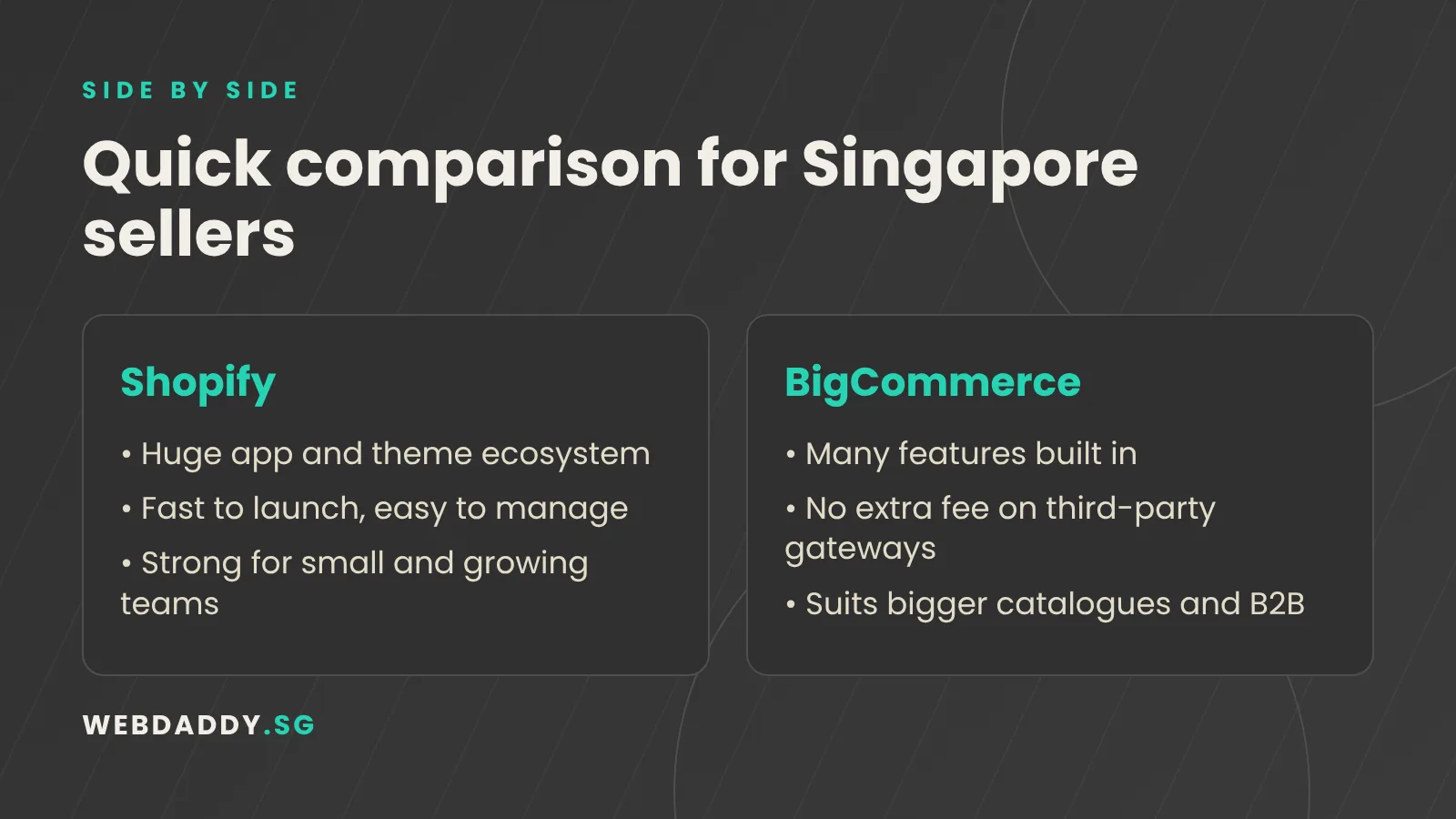
Shopify is widely known for being quick to launch and simple to run. Its admin is clean, themes install in minutes, and non-technical staff usually learn it without much training. BigCommerce offers more built-in features, which can mean a longer setup and a busier admin, but fewer add-ons to manage. If your team is small and you want to start selling quickly, Shopify tends to feel lighter. If you have a larger catalogue or complex product options, BigCommerce's built-in tools may save you from stacking apps. Think about who will update products every week, because that person will live in the admin. A useful exercise is to list the ten tasks your team does most often, such as adding a product, issuing a refund, changing a banner or exporting orders, and time how long each takes on a trial store. The platform that makes those routine jobs painless will save you hours every month, and that saving matters more than any headline feature.
Payments: PayNow, cards and wallets
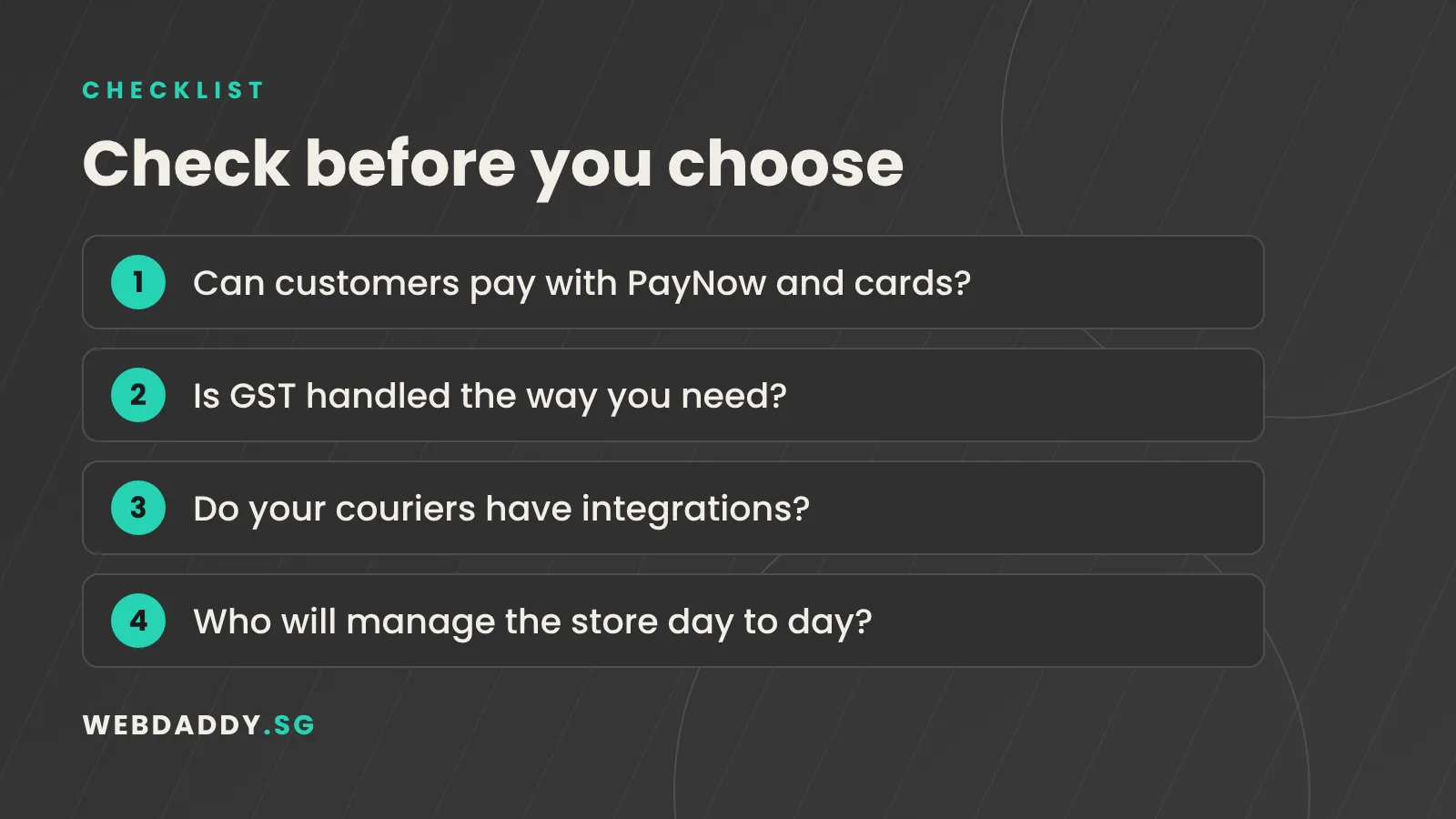
Payments decide whether a visitor becomes a customer. Singapore buyers expect cards and many also prefer PayNow, GrabPay or similar local options. Both platforms connect to major gateways, and local payment providers offer plugins or integrations for them, but support differs by provider and changes over time. Always confirm that your chosen gateway supports your business type, your settlement bank and the methods you want before you commit to a platform. Test a real checkout on a phone, including a PayNow payment if you offer it, because a payment flow that works on a laptop can still be awkward on mobile.
Transaction fees and the real cost of running a store
Compare total cost, not just the monthly plan. Look at the subscription, the transaction fees charged by the platform, the payment gateway's own fees, the apps you will need, and the theme or developer costs. Shopify has historically added an extra platform fee when you use an external gateway instead of its own payments, while BigCommerce does not add a platform fee on third-party gateways, but plan tiers and rules change, so check the current pricing pages. Run a worked example using your expected monthly sales and average order value, and add the app subscriptions you cannot live without.
GST, invoicing and price display
Businesses registered for GST need their stores to display and calculate prices correctly. Decide whether you will show prices inclusive of GST, which is common for Singapore consumers, and how invoices and receipts will be generated. Both platforms have tax settings that can be configured for Singapore, and accounting integrations such as Xero can help with records. The details depend on your registration and products, so confirm the setup with your accountant before launch. Getting this right early prevents awkward corrections and keeps your customers' totals consistent from product page to payment. If you sell across borders, remember that GST treatment can differ for exports, so ask your accountant how overseas orders should be handled and make sure your checkout can reflect it.
Shipping and fulfilment in Singapore
Singapore is compact, so customers expect fast delivery and clear tracking. Check how each platform connects to the couriers you plan to use, such as SingPost, Ninja Van or same-day options, either through native tools or through apps. Think about flat-rate shipping, free-shipping thresholds, self-collection points and cross-border shipping if you sell to Malaysia or beyond. Test the rate calculation with real parcel sizes. If you run a warehouse or use a fulfilment partner, ask whether an integration exists, because manual order exports become a daily headache once you grow. Do not forget returns. Offer a clear returns policy and a simple way to arrange pick-ups or drop-offs, because Singapore shoppers often decide to buy based on how easy it is to send an item back.
Themes, apps and design flexibility
Shopify has a very large app and theme ecosystem, which means almost any feature, from subscriptions to loyalty points, has an app for it. The trade-off is that too many apps slow the store and add monthly fees. BigCommerce includes more out of the box, and its developer tools are strong for custom builds. Whichever you pick, design matters: a store that looks trustworthy and loads fast converts better than one stuffed with plugins. A good agency will choose a lean set of apps and customise the theme to match your brand rather than rely on defaults.
SEO, speed and mobile performance
Both platforms give you the basics: editable titles and descriptions, clean URLs, sitemaps and redirects. What separates good results is how the store is built. Compress product images, keep apps to a minimum, write unique product descriptions and structure collections around the way people search. Speed matters on mobile networks, so test your product and checkout pages with Google PageSpeed Insights. If organic traffic is a priority, plan your category structure and content before launch. Our guide on how to do Shopify SEO covers the practical steps in more detail. Structured data for products, such as price, stock status and reviews, helps your listings stand out in search results, so ask your developer to confirm it is set up correctly on whichever platform you choose.
Growing: B2B, multi-currency and cross-border selling
If you plan to sell to businesses, offer customer-specific pricing or expand into other countries, check how each platform handles those needs. BigCommerce has long been popular for B2B and larger catalogues, while Shopify offers a route to more advanced features through its higher plans, including Shopify Plus for larger operations. Multi-currency, multiple languages and regional storefronts are possible on both, with different setups and costs. You do not need every feature today, but you should know where the ceiling is before you build your first thousand products.
A checklist before you decide
Write down your answers to a few questions. What payment methods must you support on day one? Who will manage products and orders? How many products and variants will you have in a year? Which couriers do you use? What integrations, such as accounting, inventory or CRM, are essential? What is your realistic monthly budget, including apps and support? Then trial both platforms with a handful of products and a test checkout. Ten honest hours of testing beats weeks of reading comparison tables, and it shows which admin your team actually enjoys using. Also make a note of the support you will need. Some businesses are happy to manage the store themselves, while others prefer a local team on call for fixes, campaigns and updates; both platforms work well with an agency partner nearby.
Which platform suits which Singapore business?
A small brand, boutique or home-grown product business that wants to launch fast and rely on a large app ecosystem often does well on Shopify. A business with a big catalogue, complex variants or B2B pricing may appreciate BigCommerce's built-in features. A retailer with physical outlets may prioritise point-of-sale and inventory sync, which should be checked on both. There is no universal winner, which is why the best next step is a short conversation about your products, customers and goals, followed by a proper quotation. Remember that your first platform choice is not a life sentence, but treating it as a three-year decision keeps you honest about growth, budget and the features you will need as you scale.
Build your store with Webdaddy
Webdaddy designs and builds fast, conversion-focused online stores for Singapore businesses, and our Shopify and e-commerce service covers setup, payments, shipping, migration and growth. We show you three design directions before you pay, and we can pair your launch with SEO and Google Ads to bring in your first customers. Message us on WhatsApp at +65 8083 8785, email support@webdaddy.sg, or book a free consultation and we will help you choose the right platform.
Call +65 8083 8785Email support@webdaddy.sg
Frequently asked questions
Is Shopify or BigCommerce cheaper for a Singapore store?
It depends on your sales volume, payment gateway and the apps you need. Compare the subscription, transaction fees, gateway fees and app costs together using your expected monthly sales. Pricing changes, so check the current plans before deciding.
Can I accept PayNow on my online store?
Often yes, through a payment provider that supports PayNow and integrates with your platform. Support varies by provider, so confirm it before you build your checkout around it.
Can I move from one platform to the other later?
Yes, but it takes planning. Products, customers, redirects and SEO all need to be migrated carefully, so it is better to choose well at the start.
Will Webdaddy build and manage my store?
Yes. We handle design, setup, payments, shipping integrations and launch, and we can support you afterwards with maintenance, SEO and advertising.