
Someone walking out of an MRT station says, "Hey Google, where is the nearest aircon servicing company open now?" and a single answer is read back. There is no page two, no scrolling and no second chance. Voice search rewards businesses that answer clearly, locally and quickly. This guide explains how people actually speak their searches in Singapore and how to shape your website so assistants and search engines choose you.
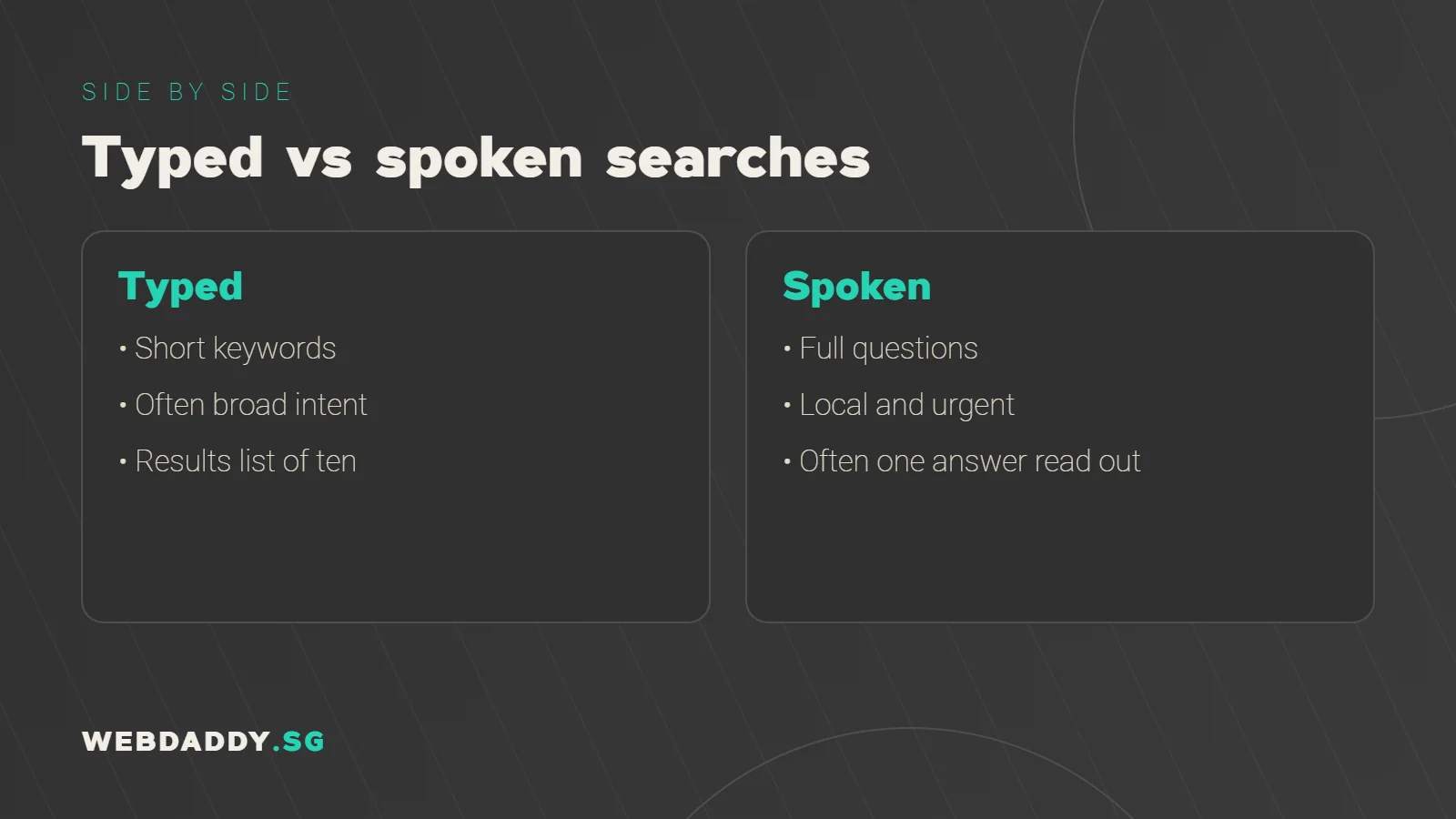
Voice search rarely gives a list of ten results. It gives one answer, so your goal is to be the most useful, most trusted and easiest-to-understand source for that question.
How voice search works in everyday life
Voice search happens through phones, smart speakers, cars and wearables. Assistants convert speech into text, run a search, and then either read out a single result or show a short list on screen. Because people are often busy, such as driving, cooking or commuting, they ask practical questions with immediate intent: opening hours, directions, prices, and "near me" services. For a business, this means voice visibility depends on the same fundamentals as regular SEO, plus a stronger emphasis on clear answers, accurate local information and fast, mobile-friendly pages. The prize is not just traffic but a phone call or visit from someone ready to act.
Why conversational queries are different
Typed searches tend to be short, such as "dentist Tampines". Spoken searches are longer and more natural: "Which dentist in Tampines is open on Sunday?" They often start with question words like who, what, where, when, why and how, and they are more likely to include context such as time, place and urgency. In Singapore you may also hear local phrasing, mixed languages and place names that assistants need to interpret correctly. Understanding how your customers phrase questions out loud gives you a goldmine of long-tail keywords that competitors overlook, and they tend to signal strong buying intent.
Find the questions your customers really ask
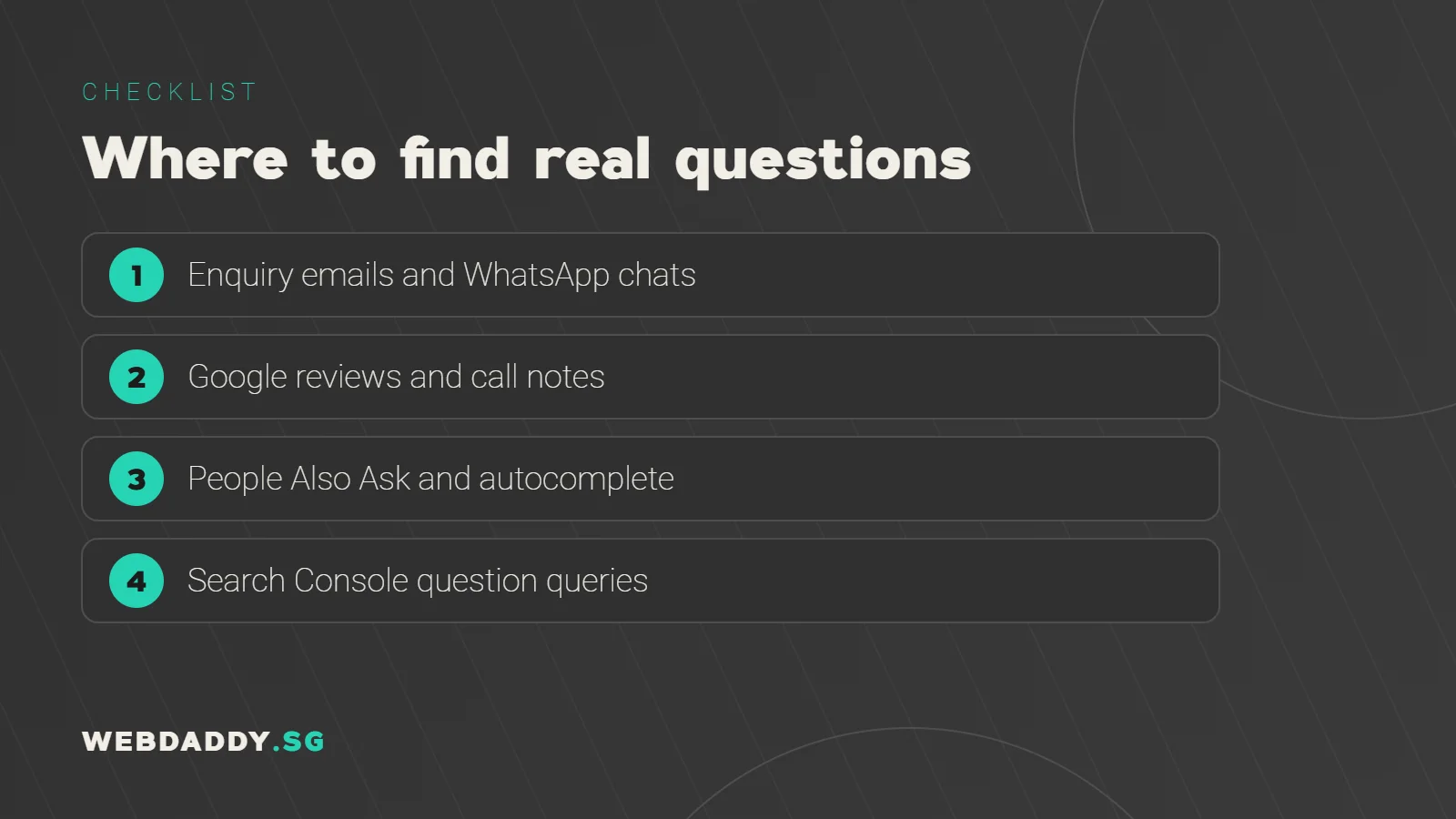
Start with the sources closest to your customers. Review your enquiry emails, WhatsApp chats, call notes and Google reviews, and write down the exact questions people ask before they buy. Then add insights from tools such as Google's People Also Ask boxes, autocomplete suggestions and Search Console queries. Group the questions by stage: awareness, comparison and decision. Prioritise the ones that you can answer better than the current top results. A simple spreadsheet of fifty real customer questions is more valuable than any generic keyword list, because it reflects how people in your market actually speak.
Write direct answers followed by depth
Voice assistants favour content that answers a question quickly and clearly. A useful pattern is to place the question as a heading, then give a concise answer of one to three sentences directly beneath it, followed by deeper explanation, examples and next steps. Write in a natural tone that sounds fine when read aloud, and avoid jargon. Short, factual sentences are easier for assistants to extract, and they also help human readers skim. Do not sacrifice depth for brevity though; the quick answer earns the snippet, while the detail earns trust and conversions.
Aim for featured snippets and rich answers
Many spoken answers are drawn from the same sources that appear in featured snippets at the top of search results. To compete, structure content so that it is easy to lift: use clear headings, numbered steps for processes, bullet points for lists and simple tables for comparisons. Answer one question per section, and include the question wording in the heading. Check which snippets already appear for your target queries and study their format. You will not win every one, but pages that are well structured give you a far better chance than dense walls of text.
Dominate local intent in Singapore
A large share of voice queries are local. Claim and complete your Google Business Profile with accurate opening hours, categories, services, photos and a precise address. Keep your name, address and phone number consistent across directories and your website. Encourage genuine reviews and reply to them, since ratings and recency influence local visibility. Mention neighbourhoods, MRT stations and landmarks that real customers use. If you serve multiple areas, create helpful pages for each rather than thin, duplicated ones. The more clearly you signal where you operate, the more likely an assistant will recommend you for "near me" requests.
Build FAQ sections and use schema
FAQ sections are a natural home for conversational questions. Add a short FAQ to your key service and location pages, using the real questions you collected and honest answers. Where appropriate, add structured data so that search engines can understand the content more easily, and make sure the markup matches what is visible on the page. Remember that rich result eligibility changes over time, so treat schema as a way to clarify your content rather than a guaranteed shortcut. The FAQ itself brings value either way, because it answers objections before a customer needs to call.
Speed and mobile experience still matter
Voice users are on the move, which means mobile networks and small screens. If an assistant sends someone to your page and it takes ages to load, they will leave. Compress images, reduce heavy scripts, use reliable hosting near Singapore and test your Core Web Vitals regularly. Make phone numbers tappable, put opening hours and directions where they are easy to find, and ensure your contact buttons work properly on all devices. A fast, uncluttered mobile page gives voice-driven visitors exactly what they need in the least amount of time.
Optimise for multilingual and local phrasing
Singapore's audience speaks English, Mandarin, Malay, Tamil and casual Singlish, often switching between them. You do not need to write in slang, but you should recognise how people describe your service. A customer might say "aircon service", "air-con servicing" or "air conditioner cleaning". Include sensible variations naturally in your headings and copy. If a significant share of your customers prefer another language, consider adding key pages in that language after your English content is strong. Always keep your core business details consistent, so assistants can match them reliably.
Measure what you can and be realistic
Voice search is difficult to measure directly because analytics rarely label it. Instead, track the indicators that move with it: impressions and clicks for question-style queries in Search Console, featured snippet wins, calls from your Google Business Profile, direction requests and mobile conversions. Set a baseline, make improvements and review monthly. Be realistic: you cannot force an assistant to choose you. You can, however, make your information accurate, helpful and easy to parse, which improves every channel at once, including traditional search.
A voice search action plan for the next 30 days
In week one, collect fifty customer questions and update your Google Business Profile. In week two, rewrite your top service pages with question headings and concise answers. In week three, add FAQ sections, check structured data and fix any speed problems. In week four, test your key questions on several voice assistants and phones, note the sources they use, and compare them with yours. Repeat the cycle every quarter. Small, consistent improvements will usually beat a one-off overhaul, and you will build a library of answers that serves your customers long after the trend has passed.
Be the answer with Webdaddy
Webdaddy helps Singapore businesses show up where customers search, whether they type or speak. Our team combines SEO services with fast, mobile-first website design and local optimisation so your answers are easy to find. Message us on WhatsApp at +65 8083 8785, email support@webdaddy.sg, or book a free consultation and we will review how your business appears for the questions your customers ask.
Call +65 8083 8785Email support@webdaddy.sg
Frequently asked questions
Is voice search different from normal SEO?
The foundations are the same, but voice search puts more weight on conversational queries, direct answers, local accuracy and mobile speed. Pages that answer clearly tend to perform better for both.
Do I need to optimise for Siri, Google Assistant and Alexa separately?
Not usually. Focus on strong content, an accurate Google Business Profile and clear structured pages, and keep your listings consistent across the major directories.
Can I track voice search traffic?
Not directly, but you can monitor question-style queries in Search Console, snippet wins, calls and direction requests as signs of progress.
Can Webdaddy help my business appear for local voice queries?
Yes. We optimise your website, Google Business Profile and content so customers who ask out loud can find accurate, helpful answers from you.